
Fynbos does not thrive on stability. It thrives on change, and fire is how the land renews itself.
Drive out in the early morning and the hills look settled, as if they have looked this way for centuries. They have not. Every slope you see sits somewhere in a cycle of fire, regrowth and renewal, and the plants on it depend on that cycle to survive.
Gondwana lies inside the Cape Floristic Region, one of the most biodiverse places on Earth. Unlike a forest, fynbos does not thrive on stability. It thrives on change.
What fire does below the ground
Fynbos soils are poor in nutrients. Decomposition here relies more on fungi than on bacteria, a slow process that can hold nutrients locked inside plant material for years. Fire releases them. The ash returns what the old growth held back, and the soil feeds a new generation of plants. Much of what makes fynbos work happens out of sight, and fire is what sets it going.
Above the ground, fire clears space. Many fynbos plants need disturbance to germinate, to compete and to stop a few dominant species from taking over. Some wait in the soil for years until a fire tells them it is time.
Why every burn is planned
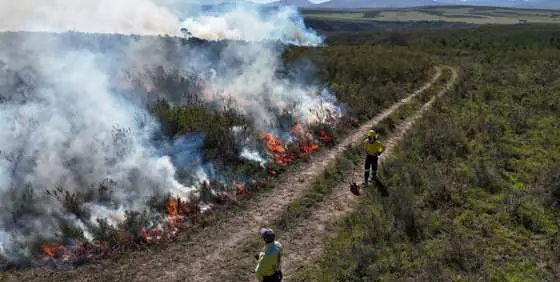
Left alone, fynbos burns on its own schedule, and not always safely. On a reserve with lodges, villas and roads, fire has to be planned. The conservation team works through a programme of controlled burns, choosing the season, the weather and the block of land so that each fire does its work and stays where it belongs. If you see smoke on the horizon during your stay, it is most likely one of these, and your guide can tell you which part of the reserve is being renewed.
A landscape that remembers its farming past
Much of Gondwana was once farmland. Sheep, cattle and ostriches grazed here, and wheat and peas grew where fynbos now returns. That history simplified the landscape, and its effects do not disappear overnight. Where fire and grazing have not yet caught up, the team uses targeted slashing, cutting back dominant growth on the old pastures to make room for a wider range of plants. The same work keeps firebreaks and roads clear and reduces fuel around the lodges and homes.
Black wattle is part of the same story. An invasive tree from Australia, it crowds out fynbos and grassland and takes water the land needs. Clearing it, by hand on the ground and from the air, is some of the most important conservation work on the reserve. In places the dead wattle is left standing on purpose, giving shelter from the wind, shade for young indigenous plants and perches for raptors.
Elephant and buffalo as gardeners
Fire is not the only force at work. Elephant and buffalo feed, trample and push through dense vegetation, opening pathways and creating the variety of structure that other animals and plants rely on. Both were absent from this region for over two centuries before they were reintroduced, and the landscape is still adjusting to their return. When you watch an elephant pull down a branch on your drive, you are watching fynbos being managed the oldest way there is.
What to look for
On a guided walk, ask your guide to show you ground at different stages since its last fire. Freshly burnt land with the first green shoots coming through the black. Younger fynbos, open and full of flowers. Older stands, taller and denser, waiting for their turn. Walks are part of every stay, arranged directly with your guide or at reception.
In fynbos, the question is never whether to disturb the land. It is how to do it responsibly, in the right place, at the right time and in the right way.